Construction Site Safety Near Schools: Why Standard Site Security Isn’t Enough.
Construction sites bordering an operating school carry legal duties that go beyond standard site security. This article explains why children can't be relied on to spot hidden hazards, sets out the OHS Act, Construction Regulations and NRSO screening requirements that apply, and gives contractors and clients a practical checklist covering fencing, excavation safety, traffic control, dust suppression and workforce vetting on school-adjacent sites.
Construction Site Safety Near Schools: Why Standard Site Security Isn’t Enough
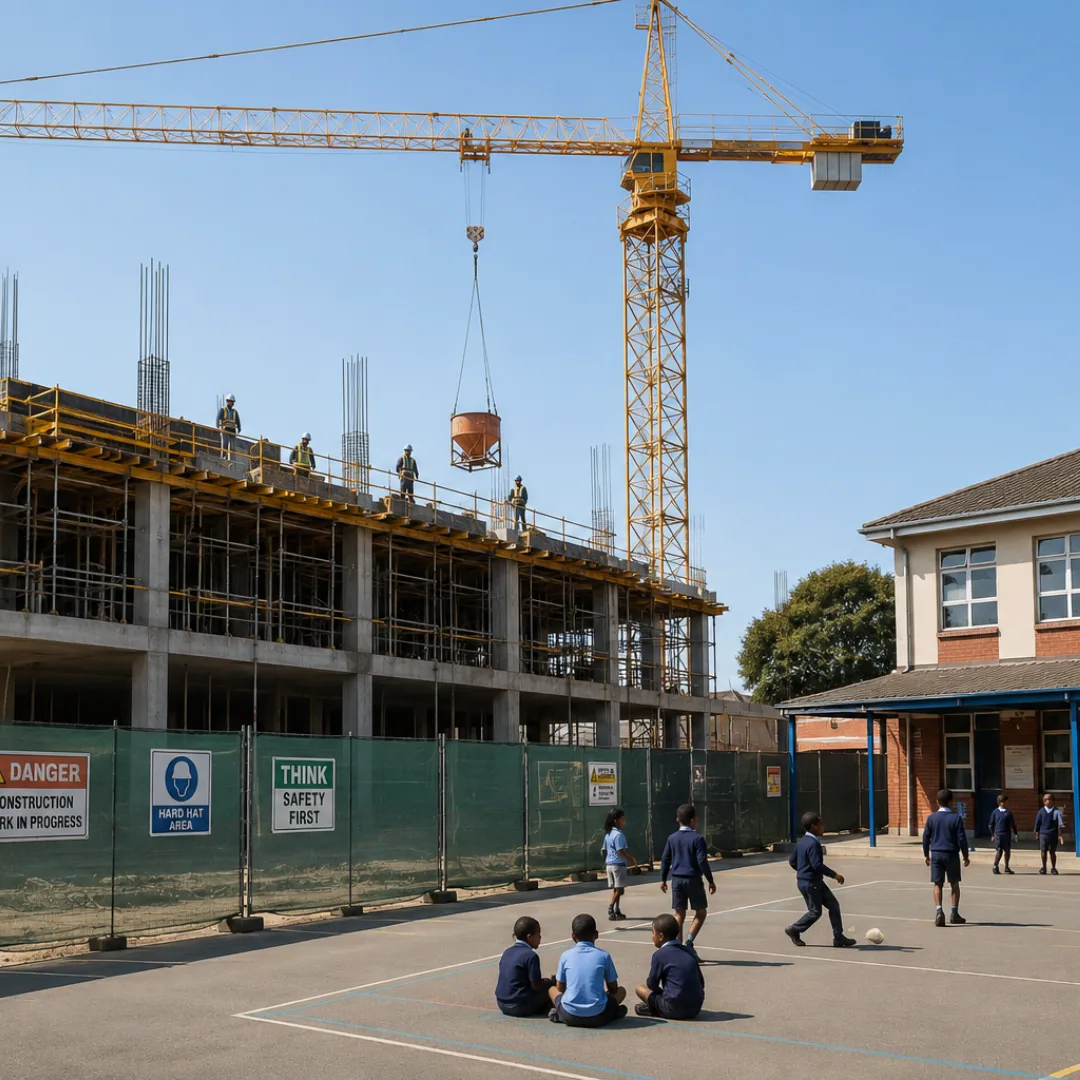
Construction site safety near schools demands more than a standard occupational health and safety (OHS) approach. When work takes place on or next to an operating school, the site is no longer bordered only by workers and the public — it is bordered by children who, developmentally, cannot be relied upon to recognise a hazard the way an adult would. This article sets out why child-focused risk control is non-negotiable on these sites, what South African law requires, and what a defensible set of practical controls looks like on the ground.
Why Children Can’t Be Relied On to Self-Protect on a Construction Site.
Conventional site safety planning assumes a baseline level of risk awareness in anyone who enters a work area. That assumption does not hold for children. Neuroscience research indicates that the prefrontal cortex — the region responsible for evaluating consequences, weighing long-term risk and exercising impulse control — only reaches full maturity between the mid-20s and early 30s. Brain development proceeds broadly back to front: primal functions such as vision and movement mature first, while the prefrontal cortex, seated just behind the forehead, finishes last. The brain reaches roughly 95% of its adult size by age six, but internal wiring — including myelination, which speeds up decision-making — keeps changing for decades, peaking at around age 30.
The practical implication: children’s reward-seeking limbic system is already highly responsive to novelty and thrill, while the prefrontal cortex’s “braking” system is still developing. Children can be genuinely skilled at evaluating risks they can test directly — judging whether a tree branch will hold their weight, for instance — but cannot reliably foresee hidden, systemic dangers such as an unfenced excavation, an unattended vehicle with the key in the ignition, or a stockpile that looks like a play feature. Because children process these two categories of risk so differently, responsibility for their safety cannot be left to their own judgement — it has to sit with engineered and administrative controls.
Key Child Safety Requirements for Construction Sites Near Schools.
Where a project is running on or next to an active school ground, managing public safety moves from standard practice to an absolute priority, and it typically covers five interlocking areas of control:
- Perimeter security and fencing: a continuous, unclimbable barrier that fully encloses the construction activity, storage yards and lay-down areas, with controlled and monitored access points.
- Site separation and access control: excavations, shafts, openings, machinery and elevated access points secured or removed from reach when unattended, so nothing hazardous is left accessible or running.
- Traffic and operational controls: construction traffic separated from pedestrian routes where possible, movements restricted around peak school times, and personnel clearly identifiable on site.
- Environmental and hazard management: dust suppression, noise-generating work scheduled outside instructional hours, and prompt securing of open excavations at the end of each shift.
- Workforce vetting and safeguarding: background screening of personnel, and administrative controls that govern how workers may interact with children on or near the site.
The specific figures quoted for these controls — fence height, mesh aperture size, time-restriction windows — are Cairnmead’s own specification standard, informed by the applicable legislation, and are not in every case verbatim statutory wording. This distinction is maintained throughout.
Risks and Challenges of Construction Work Next to a School.
The core challenge is that children are drawn to exactly the features a site cannot make safe by ordinary means: dirt piles, trenches, machinery and gaps in fencing read as points of interest, not danger. Left unmanaged, this risks a child accessing an excavation, climbing a stockpile, contacting moving plant, or inhaling dust blown toward classrooms. There is also a safeguarding risk: an active site puts adult workers in daily proximity to children, which is why workforce vetting is a control measure in its own right, not an HR formality.
A further challenge is balancing these controls against project needs — deliveries and machinery movements still have to happen. The answer is to design the programme around the controls: restricting high-risk movements to low-footfall periods, using flagmen where interface with the public can’t be avoided, and scheduling disruptive activities like drilling or demolition outside school hours.
Legal and Regulatory Requirements for School-Adjacent Construction Sites in South Africa.
A number of statutory instruments are directly relevant to a construction project on or next to a school, set out below with a clear distinction between what each instrument actually requires and where Cairnmead has applied its own specification standard on top of that baseline.
Occupational Health and Safety Act 85 of 1993, Section 9
Section 9 of the OHS Act imposes a general duty on employers and self-employed persons toward people who are not their own employees. Section 9(1) requires that “every employer shall conduct his undertaking in such a manner as to ensure, as far as is reasonably practicable, that persons other than those in his employment who may be directly affected by his activities are not thereby exposed to hazards to their health or safety.” Section 9(2) places an equivalent duty on self-employed persons. On a school-adjacent site, learners, teachers and the public fall within this protected class — the statutory foundation for a total-exclusion approach to site security.
Construction Regulations, 2014 (GN R84)
Regulation 5 sets out the client’s duties, including appointing a Construction Health and Safety Agent (CHSA) in writing and ensuring the health and safety specification addresses the presence of children where relevant. Regulation 7 places corresponding duties on the principal contractor to implement site security, fencing and traffic controls per the approved plan. Regulation 13 requires that any excavation accessible to the public, or adjacent to public roads or thoroughfares, be protected by a barrier or fence at least one metre high, positioned as close to the excavation as practicable, regardless of depth — a direct statutory requirement. Cairnmead’s own standard goes further on some sites, requiring openings deeper than one metre to be backfilled, boarded or fenced by the end of each shift; this deeper-than-one-metre trigger is Cairnmead’s specification standard, not a separate legislative threshold.
Criminal Law (Sexual Offences and Related Matters) Amendment Act 32 of 2007
This Act, as amended by Act 13 of 2021, establishes the National Register for Sex Offenders (NRSO), administered by the Department of Justice and Constitutional Development. Under Chapter 6 and its regulations, employers whose staff work with or around children — including site personnel on a school-adjacent project — must check that staff are not listed on the register. Form J738 (Regulation 17(1)) lets an individual check their own status; Form J739 (Regulation 17(2)) is what an employer or other authorised party uses to check another person’s status before engaging them. Screening site personnel is a direct extension of this duty, not simply good practice.
National Environmental Management: Air Quality Act 39 of 2004
Together with the environmental provisions of the OHS Act, this Act underpins control of dust and airborne particulate emissions from a construction site. Children are more susceptible to respiratory irritants than adults, so active dust suppression — wetting down stockpiles and haul roads, and covering stockpiled material — is a mandatory control on school-adjacent sites, not a good-practice suggestion.
Supporting Guidance
The Department of Basic Education’s School Infrastructure Safety and Security Guidelines (2017, draft v1) offer useful sector-level guidance, but they are supporting guidance — not the operative safety-in-construction instrument for a project, a role filled by the OHS Act and Construction Regulations described above.
Practical Application: Who Is Responsible for Child Safety on a Construction Site.
The table below maps these statutory duties onto the parties typically involved in a school-adjacent project.
| Duty Holder | Statutory Basis | Key Obligation on School-Adjacent Projects |
| Client | OHS Act s37(2); Construction Regulations, reg. 5 | Appoints the CHSA/agent in writing; ensures the health and safety specification includes child-safety measures before tender. |
| Principal Contractor | Construction Regulations, regs. 5 & 7 | Implements site security, fencing and traffic controls in line with the approved health and safety plan. |
| CHSA / Health & Safety Agent | Construction Regulations, reg. 5(7); SACPCMP registration | Audits compliance, verifies vetting documentation and reports non-conformances to the client. |
| Contractor / Subcontractor | OHS Act ss8–9; Construction Regulations, reg. 5 | Day-to-day compliance: fencing maintained, workforce vetted, PPE and signage in place. |
In practice, the CHSA plays a central verification role: auditing that fencing, access control and traffic measures are in place, that vetting documentation exists for every person on site, and that non-conformances are reported to the client without delay.
Recommendations for Contractors and Clients Working Near Schools
- Build child-safety measures into the health and safety specification before tender, not as a variation once the project is underway.
- Treat perimeter fencing as a barrier designed to defeat a determined, curious child — not simply to mark a boundary.
- Secure every excavation, opening and item of unattended plant at the end of every shift, without exception.
- Schedule disruptive, noisy or dust-generating activity outside instructional hours wherever the programme allows.
- Screen all site personnel against the National Register for Sex Offenders before they are permitted on site, and keep that documentation current for the duration of the project.
- Make the CHSA’s audit function real: verify compliance on site, not only on paper.
Construction work next to an active school cannot be planned, priced or supervised as an ordinary site. Children on the other side of the fence cannot fully evaluate the risks themselves, so every control — fencing, access management, traffic planning, dust suppression and workforce vetting — carries more weight than it would on a standard commercial site. A useful test: what standard of care would you want applied if it were your own child on the other side of that fence? Applying that standard consistently is what compliance on these projects looks like.
References
- Occupational Health and Safety Act 85 of 1993, Section 9 — duty to persons other than employees.
- Construction Regulations, 2014 (GN R84), Regulations 5, 7 and 13 — duties of client/agent, principal contractor, and excavation safety.
- Criminal Law (Sexual Offences and Related Matters) Amendment Act 32 of 2007, as amended by Act 13 of 2021, Section 46 and Chapter 6 (National Register for Sex Offenders); NRSO Regulations, Form J738 (Regulation 17(1)) and Form J739 (Regulation 17(2)).
- National Environmental Management: Air Quality Act 39 of 2004 — dust and particulate emission control.
- Department of Basic Education, School Infrastructure Safety and Security Guidelines (2017, draft v1) — supporting sector guidance.
- SACPCMP registration requirement, Construction Regulations, 2014, Regulation 5(7) — statutory basis for CHSA/agent appointment.